The ultimate guide to contract summaries
- Contract summaries highlight the key terms, obligations and risks in an agreement.
- They help legal and business teams review contracts faster and with greater consistency.
- AI can generate first drafts, reducing manual work across high volumes of contracts.
- Human review remains essential for validating legal and commercial context.
Anyone who works with contracts on a daily basis knows how valuable the information inside them is – from key commercial terms to renewal dates and obligations that shape how the business operates.
The opportunity is making that information easy to access and use across the business. With the right approach, teams can quickly find answers to questions around notice periods, early termination rights and liability caps, without working through entire agreements or relying on legal for repeat queries.
Without that visibility, the impact adds up: missed obligations, unintended renewals and increased exposure to risk. In fact, research show that poor contract management can cost organizations up to 9% of annual revenue, often driven by these gaps in visibility.

This is where contract summaries and AI contract summary tools come in.
What are contract summaries?
A contract summary is a concise overview of the key commercial and legal terms contained within a contract. It typically captures parties, dates, obligations, payment terms, renewal provisions, termination rights and major risks, giving legal teams (and the wider business) a faster way to understand agreements without manually reviewing every clause.
They turn contracts from static documents into structured, accessible information, making it easier for everyone to understand key terms without starting from scratch each time.
Why are contract summaries important and who uses them?
Contract summaries matter because they make key contract terms accessible without reading full agreements.
- Legal teams use summaries to quickly understand key terms, assess risk and get up to speed on contracts without reading them end-to-end each time. This is especially useful when reviewing third-party agreements or managing large volumes of contracts.
- Sales teams use summaries to check commercial terms like pricing, renewal dates and notice periods, especially when managing renewals or negotiating with existing customers.
- Procurement teams rely on summaries to understand supplier obligations, payment terms and termination rights, helping them manage vendor relationships more effectively.
- Finance teams often need visibility into payment structure, billing triggers and contract value, all of which can be surfaced through a well-structured summary.
- Wider business stakeholders – ultimately, summaries reduce reliance on legal by giving non-legal teams access to the information they need without having to interpret full contracts themselves.
{{quote 1}}
How does AI contract summary software work?
AI contract summary software extracts key terms like data, pricing and risk clauses, directly from a contract using natural language processing. It then structures that data into a consistent summary format, stores it alongside the original contract and updates it automatically whenever the contract is amended.
This happens in a few steps:
Contract intake
Contracts are uploaded into the tool, whether it’s third-party paper, legacy agreements or newly executed contracts. AI models can process a wide range of contract formats, making it easier to standardize and analyze documents at scale.
Data extraction
AI can identify and extract key terms from the contract, such as:
- Key dates e.g. effective, renewal and expiry dates
- Commercial terms e.g. pricing, payment triggers
- Risk clauses e.g. liability, indemnities, termination rights
Instead of manually locating this information, AI can recognize patterns in language and surface the relevant clauses automatically. This is typically done using natural language processing (NLP) models that have been configured using large volumes of contracts, allowing them to understand how key terms are phrased across different agreements.
Structured summary generation
Instead of producing a free-text summary, AI can map extracted terms into a standardized summary format. That means every contract is summarized consistently, making it easier to:
- Compare agreements
- Search across contracts
- Report on key terms
Centralized storage and linking
Summaries are stored alongside the original contract, creating a single source. Because summaries are generated from the contract itself, AI helps make sure they stay aligned with the latest version rather than becoming outdated static documents.
Search and retrieval
AI-powered search allows teams to quickly find specific terms across their contract portfolio, such as contracts with auto-renewal clauses, agreements with specific liability caps and any upcoming renewal dates. This goes beyond keyword search, helping teams surface relevant information based on meaning and context.
Ongoing tracking and updates
More advanced platforms, such as full contract lifecycle management (CLM) tools use the AI-extracted data to power ongoing contract management, including tracking obligations and key milestones, monitoring renewal and notice periods and supporting compliance and reporting. As contracts are updated or amended, AI can reprocess the document and update summaries dynamically, reducing the risk of outdated information.
ACC’s benchmark report estimates that legal teams spend up to 40% of their time manually managing contracts. If you had AI contract summary software that automatically extracted key terms like renewal dates, notice periods and liability caps into an easy-to-understand, digestible format for you and your non-legal teams, just think how much time this could save.
{{download 1}}
Manual vs AI contract summaries: at a glance
How do contract summaries support the wider contract lifecycle?
Once created, contract summaries don’t sit in isolation. They support the broader contract lifecycle by making key information visible and usable at every stage.
- During contract creation and drafting, standardized summaries help ensure key terms are consistently captured from the start, reducing the risk of important details being missed and making contracts easier to manage downstream.
- During review and negotiation, summaries provide a clear view of commercial and risk terms, making it easier to compare versions, spot deviations and move negotiations forward without repeatedly reviewing full documents.
- Post-signature is where summaries deliver the most value – they enable teams to track obligations, manage renewals and understand contract risk without needing to revisit the full agreement. This is often where the biggest gaps exist without a structured approach, leading to missed deadlines, unintended renewals and limited visibility into contractual commitments, all of which could cost your business money.
How does Summize handle contract summaries?
Contract summaries have been part of Summize's CLM from the beginning – it’s actually the original tool our platform was built around!
That means we’ve designed our contract summary tools around how businesses actually use contract data day to day. What does that look like in practice?
- Automatic summaries in seconds – key terms like renewal dates, notice periods and liability caps are extracted and structured without manual input.
- Summaries embedded alongside the contract – legal teams can quickly review key terms without needing to read the full document, while still having direct access to the source contract
- Searchable, structured data across the contract portfolio – meaning you can easily find contracts based on specific terms rather than searching document by document.
- Access to summaries across the business – commercial teams can view the information they need without relying on legal, helping reduce bottlenecks and speed up decision-making.
- Used within existing workflows and tools – whether working in the Summize CLM itself or alongside other business systems, summaries are designed to surface contract data where teams already work.
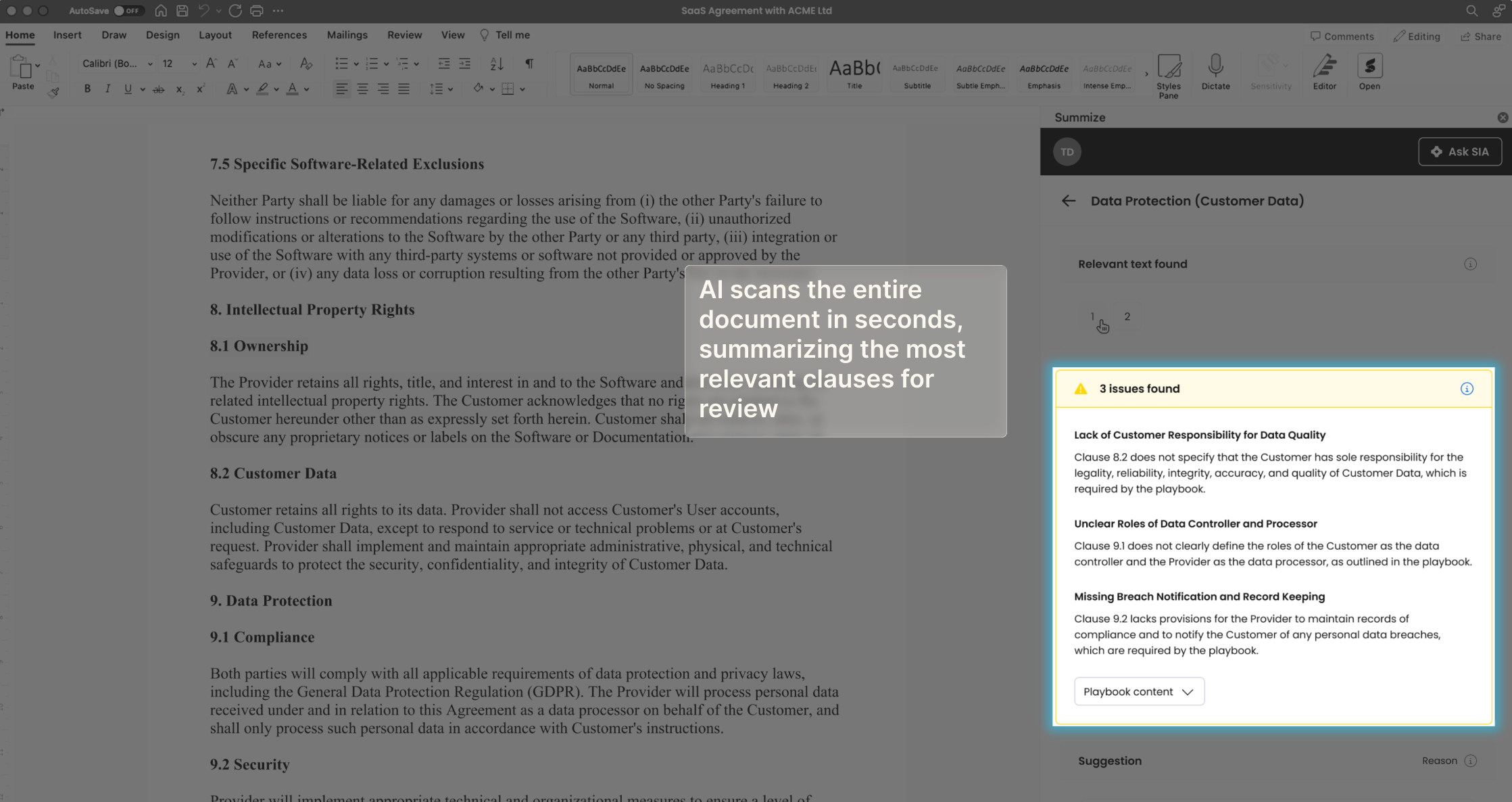
- Accelerated contract review – instead of line-by-line manual checks, AI can scan an entire document in seconds, summarizing the most relevant clauses for review.
{{testimonial 1}}
Explore how Summize uses AI to help legal and business teams create consistent, scalable summaries to help the whole business understand contracts faster. Or, book a demo to see our contract summaries in action.
We use the clause summary feature extract insights and analytics from our contracts, leveraging contract information to empower our sales and marketing teams and giving our executive leadership a holistic lens on our contractual obligations.


“One of the biggest challenges we hear from in-house teams is that contract data exists, but it isn’t accessible. Contract summaries are often the bridge between the two.”