New Summize AI Fluency Report reveals a growing gap between AI confidence and business context
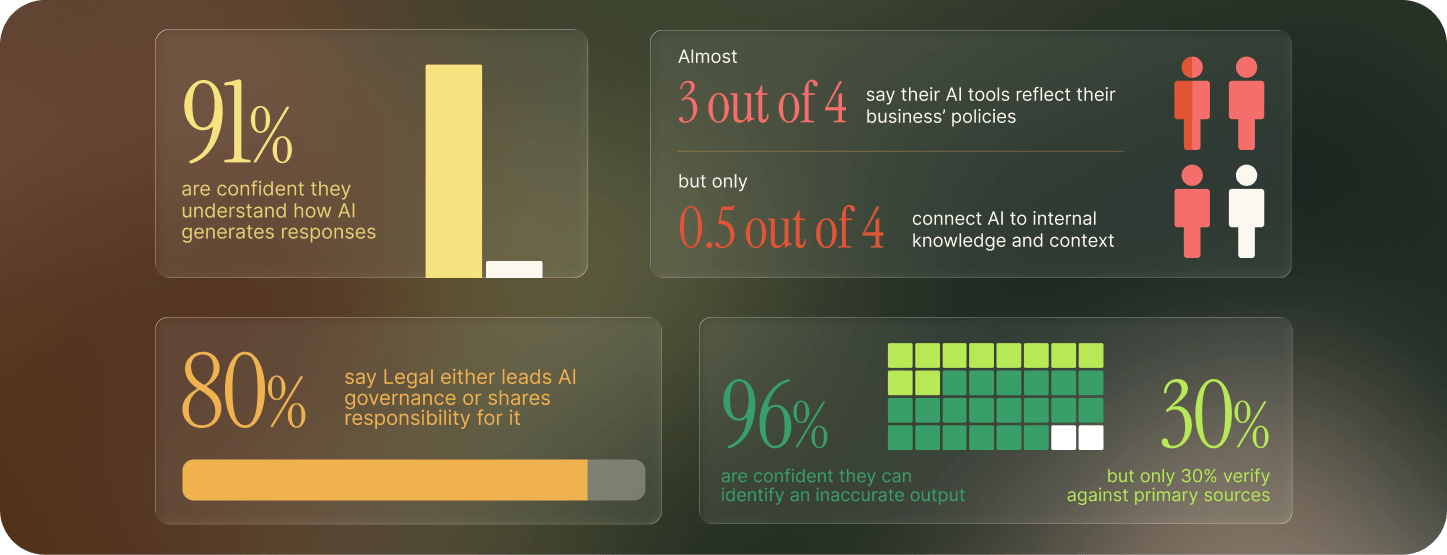
Today, we can unveil the findings of our AI Fluency Report. Of the 500+ U.S. in-house legal professionals surveyed, 96% said they are confident they can identify an AI-generated legal response that is inaccurate, incomplete or misleading. However, only 14.5% said their AI connects directly to approved internal knowledge sources, as they instead rely on saved prompts or provide context one prompt at a time.
Every respondent reported using AI in their legal work in some capacity, and almost 80% said legal either leads their organization’s AI governance or shares the responsibility with IT, security, or compliance. The findings show that legal is no longer waiting to see what AI will mean for the profession. Legal is using it and helping set the rules. The next challenge is turning this confidence into connected knowledge, repeatable workflows, and sound decisions across the business.
Confidence is the foundation, not the finish line
Legal professionals are confident in both their use and understanding of AI: 91% rated their understanding of how generative AI produces responses as advanced or expert. AI use also extends across the legal workload, from drafting and summarizing content (19.2%) to applying legal knowledge (17.2%), finding information (16.8%) and supporting commercial decisions (16.6%).
Confidence alone, however, does not determine whether an answer is right. AI fluency requires lawyers to understand the technology and decide how its output should be tested. When an AI-generated legal response looks questionable, 30% said their first step would be to verify it against a primary source. Another 23% would consult a colleague or subject matter expert, while 18% would ask the AI to explain or revise its answer. Lastly, 11% of respondents would discard the response entirely.
Legal is setting the governance standard
Almost 80% of respondents said legal either leads AI governance or shares responsibility with IT, security or compliance, while 27% said legal leads governance outright. Every respondent reported that legal has at least some input.
That position gives legal an opportunity to shape more than policy, as legal teams can help determine where AI belongs, what knowledge it should use, and when a person must remain responsible for the outcome, giving the organization clear boundaries to work within.
AI fluency is about application
Legal teams hold some of the most important knowledge in a business: its contracts, policies, negotiating positions, risk appetite and history. Three-quarters of respondents (75%) said their AI tools always or frequently reflect company policies, preferences or historical decisions, but the way that context reaches AI is usually still via manual prompting.
About 35% use saved prompts, templates or playbooks to provide internal knowledge, while 27.7% enter the context again each time they use AI. Connecting AI directly to approved sources makes the knowledge available wherever decisions are being made, without forcing legal to repeat the same guidance or become a bottleneck.
{{quote 1}}
Better AI requires sharper legal judgment
As AI improves, legal judgment becomes more important. No single capability dominated when respondents considered what in-house lawyers will need most in an AI-enabled future. AI and technology understanding ranked first at 18.6%, closely followed by governance, risk and ethics at 18.2%.
Respondents also pointed to critical thinking, strategic advice, business context, and relationship skills as important factors for future AI success. The AI-fluent lawyer should have sufficient technical understanding to use AI effectively, enough business context to judge whether an answer fits, and the confidence to take control when it does not.
Read the full report by clicking below. The research was conducted by Censuswide in July 2026, based on a sample of 505 in-house legal professionals in the United States, employed by companies with 100 to 3,000 employees. Respondents included business owners, directors, senior managers, middle managers, and junior managers across 11 industry groups.

“Legal has moved beyond the question of whether to use AI. The harder and more important question is whether AI can apply the knowledge needed to make legal advice reliable, scalable, and trusted. That requires trusted data foundations, clear escalation workflows for human review and lawyers who remain accountable for the decisions that follow.”

Frequently Asked Questions
View allInsights, updates, whitepapers
View all