2026 legal tech trends: AI, CLM and smarter workflows

As we head into 2026, the legal tech landscape is moving faster than ever.
From contract lifecycle management (CLM) to AI-powered workflows, legal teams are looking for ways to work smarter, reduce friction and focus on high-value work. Here’s a look at the legal tech trends we see shaping the year ahead, and why they matter.
1. From adoption to augmentation
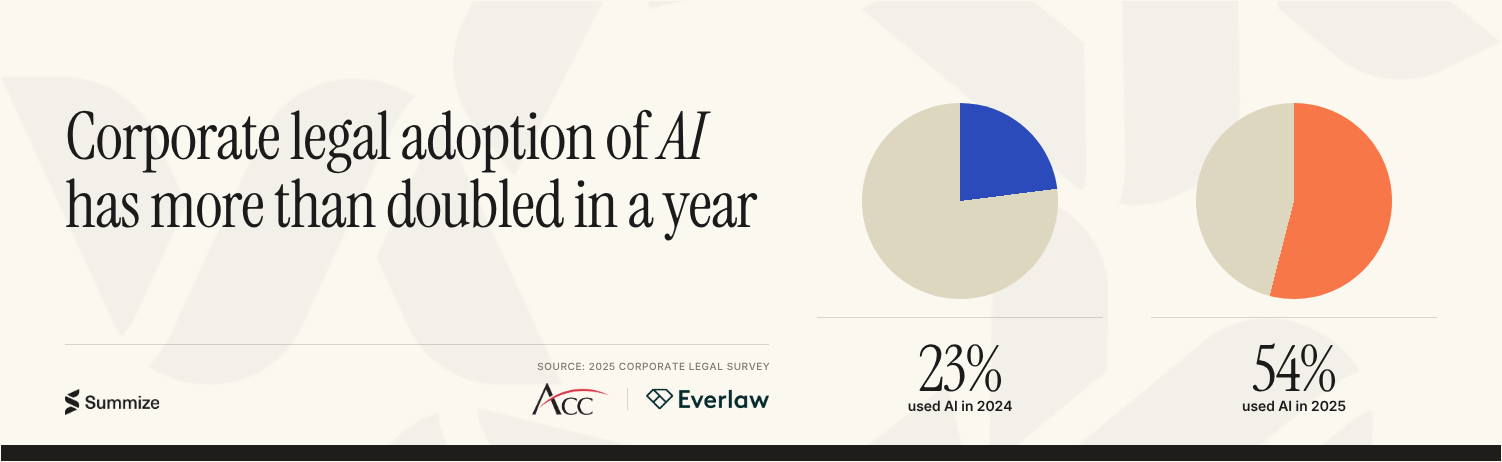
For the past several years, legal teams have focused on adopting technology – learning new systems, digitalizing processes and getting comfortable with automation. In fact, a survey by ACC and Everlaw found that corporate legal adoption of AI more than doubled in one year, from 23% in 2024 to 54% in 2025. In 2026, the emphasis is shifting to augmentation: using technology to enhance human expertise, not replace it.
This means capturing legal knowledge within workflows so that routine tasks like contract approvals, compliance checks or standard drafting can be handled confidently by the wider business, while underpinned by legal’s guardrails. Meanwhile, lawyers can focus on higher-value, strategic work such as advisory services, risk management and complex negotiations.
In practical terms, this trend represents the market maturing; legal tech isn’t just about efficiency, but empowering teams to make smarter decisions and create tangible business impact.
The near future of this is empowering the wider business to be more self-sufficient by gaining more trust and finding ways for technology and AI to use a lawyer's knowledge to carry out tasks more autonomously.
Tom Dunlop, CEO & Founder at Summize
2. Tackling hallucinations in AI tools
We all know AI can hallucinate outputs (in fact, by late 2025, researchers had already tracked over 120 court cases worldwide involving AI hallucinations) but in 2026 the trend is all about how AI platforms are tackling this issue.
Underlying this is the way LLMs generate text – predicting the most likely “next token”. Inaccuracies often arise from how these predictions are made, influenced by training data, context and the structure of the task. Results still depend on how the AI is used and the context it has – marking a shift from prompt engineering to context engineering.
One way to reduce hallucinations is structured, step-by-step analysis, which breaks complex legal tasks into smaller, validated steps, and another is retrieval-augmented generation, which uses verified sources to ground outputs. So what does this mean for legal teams? More efficiency, less hallucinations and you more in control.
3. Agentic AI: proactive and autonomous legal support
While we saw a rise in development of agentic AI in 2025, the legal tech trend in 2026 is deployment. Agentic AI are systems that don't just answer questions like traditional, reactive legal AI, but it's much more proactive. It knows the goal of what you're trying to do, any rules or guardrails you've put in place and it knows the context of your business. It moves your work forward but keeps you in control.
What does that look like in practice? Here’s a few ways agentic AI could help legal teams…
- Track key contract deadlines and flag items for review
- Extract clauses from contracts and highlight potential risks
- Route approvals or tasks based on organization rules and prior actions
However, while agentic AI promises autonomy, it’s still an evolving technology. According to Gartner, the share of enterprise software solutions incorporating agentic AI is going to rise sharply – from less than 1% now to about 33% by 2028, and by the same year at least 15% of day-to-day work decisions could be made autonomously through agentic AI.
.png)
But they do also caution that over 40% of agentic AI projects will be canceled by 2027 due to escalating costs, unclear business value or inadequate risk controls. It shows that there’s real potential there, but teams need to be thoughtful about where and how agentic AI is applied, focusing on areas with clear ROI, solid data foundations and strong oversight.
Agentic AI represents a shift from reactive tools to proactive support - systems that can progress legal work on your behalf, while keeping people in control of decisions and outcomes.
Leanne Hayes, Product Owner at Summize
{{download 1}}
4. Human connection remains central
As legal AI becomes more capable and autonomous, questions around accountability, trust and judgment come into sharper focus. In a regulated, risk-sensitive function like legal, technology can support decision-making, but responsibility ultimately remains human.
That expectation is becoming more formalized. In the US, the American Bar Association’s (ABA) Formal Opinion 512 makes it clear that lawyers have to understand AI’s capabilities and limitations and protect confidentiality. In Europe, the EU AI Act (coming into force in August 2026) classifies AI used in certain legal services as high-risk, requiring transparency, human oversight and risk management, with big penalties for non-compliance.
Against this backdrop, the role of legal professionals is only becoming more critical. The most effective teams in 2026 will combine smart technology with clear ownership and governance, using AI for repetitive work while keeping human judgment, ethical responsibility and advisory expertise at the heart of legal decision-making.
It’s important for legal professionals to understand the way that AI is involved in their business processes and to assess whether they rely solely on AI for any decision-making. Placing professionals at the heart of that decision-making will go a long way to ensuring compliance.
Thomas Pratt, Legal Counsel at Summize
5. More considered adoption of technology
Finally, a legal tech trend gaining traction is more thoughtful adoption of legal tech. Instead of just jumping on the latest tool, legal teams are asking deeper questions: What problem are we really trying to solve? How will this integrate into existing workflows? Will it deliver meaningful impact or just add complexity?
A more thoughtful approach helps organizations cut through the hype and make smarter investment decisions, which is vital when 50% of initial contract lifecycle management implementations are still failing, according to Gartner. For teams exploring new CLM solutions, resources like Summize’s Buyer’s Guide to CLM, provide a roadmap for evaluating tools and ensuring technology genuinely supports business goals.
Looking ahead
In 2026, legal AI and CLM are maturing from isolated solutions to fully integrated, intelligent workflows. Augmentation, agentic AI, human-AI collaboration and careful adoption aren’t just buzzwords, but the keys to helping legal teams work smarter, reduce friction and focus on what truly matters: high-value work that drives impact across the business.
Explore how Summize can help you get ahead with AI that helps review, analyze and manage contracts faster, while keeping people in control of teh deisions that matter.


Frequently Asked Questions
View all.webp)

.webp)

.webp)